Search


证书

SDS

引用和文献 (3)
Thermo Scientific™
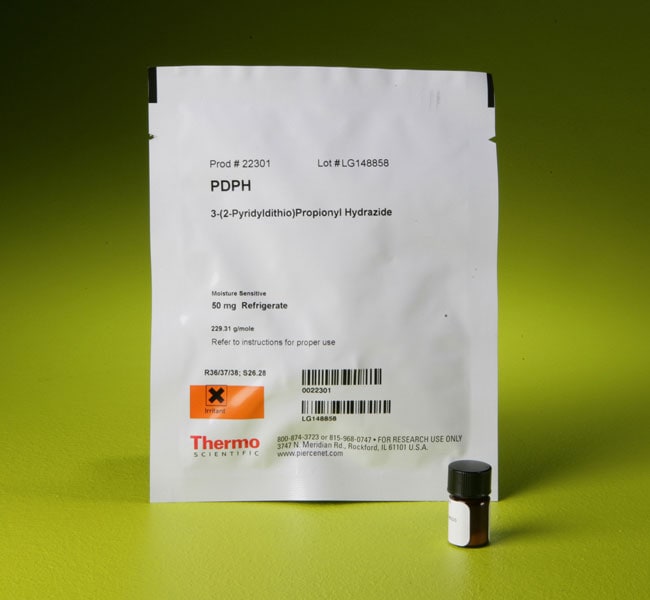
PDPH(3-(2-吡啶基二硫基)丙酰肼)
Thermo Scientific Pierce PDPH is a short, pyridyldithiol-and-hydrazide crosslinker for reversibly conjugating sulfhydryls (cysteines) to carbonyls (aldehyde or ketones, such了解更多信息
 促销
促销Promotion:【相关推荐】- 无需代码
细胞成像入门礼

999元任选3件,1899任选6件, MitoTracker、MitoSOX等爆款应有尽有!更多
| 货号 | 数量 |
|---|---|
| 22301 | 50 mg |
货号 22301
价格(CNY)
3,231.00
飞享价
Ends: 31-Dec-2025
4,124.00共减 893.00 (22%)
Each
Promotion available下单后预计有货日期 29-Dec-2025
数量:
50 mg
物流信息
常规产品: 发货后, 北上广深及省会城市通常为 1-2天,二线城市通常 2-3天,三线以及偏远地区通常 4天,周末以及节假日顺延。
空运受限产品: 发货后, 北上广深及省会城市通常为 2-4天,二线城市 通常3-5天,三线以及偏远地区通常 6-10天,周末以及节假日顺延。
现货中心: 此类产品将由您身边的现货中心极速配送。
空运受限产品: 发货后, 北上广深及省会城市通常为 2-4天,二线城市 通常3-5天,三线以及偏远地区通常 6-10天,周末以及节假日顺延。
现货中心: 此类产品将由您身边的现货中心极速配送。
价格(CNY)
3,231.00
飞享价
Ends: 31-Dec-2025
4,124.00共减 893.00 (22%)
Each
Thermo Scientific Pierce PDPH is a short, pyridyldithiol-and-hydrazide crosslinker for reversibly conjugating sulfhydryls (cysteines) to carbonyls (aldehyde or ketones, such as those formed by oxidation of glycoprotein carbohydrates).
Features of PDPH :
• Reactive groups: pyridyldisulfide and hydrazide
• Reactive toward: sulfhydryl groups and carbonyl (aldehyde) groups
• Short (9.2A), sulfhydryl-to-aldehyde crosslinker with disulfide bond spacer arm (cleavable)
• Pyridyldithiol group results in attachment to sulfhydryls via disulfide bond, which can be cleaved with DTT, TCEP or other reducing agents
• Hydrazide group conjugates to oxidized sugars of glycoproteins and carbohydrates
• Use sodium meta-periodate to oxidize glycosylation (e.g., sialic acid) to reactive aldehyde groups
• Use with EDC to conjugate primary amine of hydrazide group to carboxyl groups
Product References:
Crosslinker Application Guide -- search for recent literature references for this product
Features of PDPH :
• Reactive groups: pyridyldisulfide and hydrazide
• Reactive toward: sulfhydryl groups and carbonyl (aldehyde) groups
• Short (9.2A), sulfhydryl-to-aldehyde crosslinker with disulfide bond spacer arm (cleavable)
• Pyridyldithiol group results in attachment to sulfhydryls via disulfide bond, which can be cleaved with DTT, TCEP or other reducing agents
• Hydrazide group conjugates to oxidized sugars of glycoproteins and carbohydrates
• Use sodium meta-periodate to oxidize glycosylation (e.g., sialic acid) to reactive aldehyde groups
• Use with EDC to conjugate primary amine of hydrazide group to carboxyl groups
Product References:
Crosslinker Application Guide -- search for recent literature references for this product
仅供科研使用。不可用于诊断程序。
规格
细胞渗透性是
描述PDPH
形式粉末
标记方法化学标记
分子量229.32
聚乙二醇化否
产品线Pierce™
数量50 mg
反应一部分酰肼、吡啶二硫化物
运输条件环境
溶解度DMF、DMSO
间隔臂长9.2 Å
水溶性否
化学反应性碳水化合物-巯基
可裂解用硫醇
交联剂类型异型双功能团试剂
产品规格标准
产品类型交联剂
间隔子短 (<10 Å)
Unit SizeEach
内容与储存
接收后,请在 4°C 下干燥储存。
常见问题解答 (FAQ)
图表

Chemical structure of PDPH crosslinking reagent
浏览此商品的顾客同时也查看了
文件和下载
证书
按批号或部分批号搜索
批号Certificate TypeDateCatalog Number(s)
3230828Certificate of Analysis2025年8月14日22301
3212982Certificate of Analysis2025年5月16日22301
YK379404Certificate of Analysis2024年1月25日22301
YD358670Certificate of Analysis2023年5月06日22301
YA357113Certificate of Analysis2023年1月13日22301
显示 5 条结果, 在上面搜索特定证书
安全数据表
SDSProduct Information
引用和文献 (3)
Search citations by name, author, journal title or abstract text
引用和文献
Abstract
Systemic administration of a nerve growth factor conjugate reverses age-related cognitive dysfunction and prevents cholinergic neuron atrophy.
Journal:J Neurosci
PubMed ID:8757256
'Intraventricular administration of nerve growth factor (NGF) in rats has been shown to reduce age-related atrophy of central cholinergic neurons and the accompanying memory impairment. Intraventricular administration of NGF is necessary because NGF will not cross the blood-brain barrier (BBB). Here we have used a novel carrier system, consisting of
Conjugation of folate via gelonin carbohydrate residues retains ribosomal-inactivating properties of the toxin and permits targeting to folate receptor positive cells.
Journal:J Biol Chem
PubMed ID:11359781
Conjugation of folate to proteins permits receptor-mediated endocytosis via the folate receptor (FR) and delivery of the conjugate into the cytoplasm of cells. Since many cancers up-regulate the FR it has enabled the targeting of toxins to tumor cells resulting in specific cell death. However, current conjugation methods rely on
Site-specific modifications of light chain glycosylated antilymphoma (LL2) and anti-carcinoembryonic antigen (hImmu-14-N) antibody divalent f1agments.
Journal:Cancer Res
PubMed ID:7493334
Site-specific introduction of metal-chelating groups into F(ab')2 fragments of an antilymphoma antibody (LL2) possessing a natural Asn-linked light chain carbohydrate and an anti-carcinoembryonic antigen antibody (hImmu-14-N) grafted with a light chain carbohydrate site is described. For this purpose, four yttrium- (and indium)-chelating agents were used, containing a primary amino group
3 total citations